 VERTICE
From the Safety Brake to the Spec Book: A History of Elevator Consulting
Every story about tall buildings starts with the same problem. In 1852, in a bedstead factory up in Yonkers, a mechanic named Elisha Otis needed to hoist heavy loads to an upper floor, and he was tired of worrying about the rope letting go.
It started with a rope that wasn't allowed to fail
What Otis built was a spring loaded safety brake. The second the rope went slack, a set of spring loaded pawls snapped into a toothed guide rail and locked the platform in place. It wasn't really an elevator yet. It was a promise that the thing would not fall. In 1854 he sold that promise the best way anybody ever has. At the Crystal Palace Exhibition in New York he stood on a raised platform in front of a crowd and had a man cut the only rope holding him up. The platform dropped an inch and stopped. You can picture the room going dead quiet, then loud.
Here is what that actually did. Before a safe elevator, a building topped out around five or six stories, because nobody wanted to climb higher than that. Upper floors sat empty or filled up with storage. Otis took the lid off. By 1857 the first passenger safety elevator was carrying customers at E. V. Haughwout and Company, a fancy glass and china store on Broadway. By 1870 the Equitable Life Building was using its elevators as the reason it could rent out eight full floors of offices. And by 1902 and 1903, the Otis gearless traction machine made a fast, smooth, genuinely tall building an ordinary thing to put up. People like to say the elevator followed the skyscraper. It is the other way around. The elevator is what made the skyscraper possible in the first place.
The industry outgrew the people who built it
For a long stretch, the elevator was simple enough that the company who built it and installed it was also the company telling the owner what to buy. Otis, then Westinghouse, Haughton, a handful of others. There was no such thing as an independent expert working only for the owner. The manufacturer was the salesman, the engineer and the installer all in one, and everybody just accepted that.
That stopped working as buildings got taller and the systems got complicated. Through the 1960s and 70s, cities were putting up towers at a pace nobody had seen, and the elevator package in one of those towers was no longer something you picked off a shelf. It was a real engineering decision that drove how the building ran, what it cost to operate, and whether it was safe. Big engineering houses like Jaros, Baum and Bolles and Syska and Hennessy started writing elevator and escalator specs and inspecting the work in the field, right alongside their mechanical and electrical drawings. Around the same time a few individuals, John Miller and Charles Lerch among them, went out on their own and built practices that represented the owner and the architect instead of the manufacturer. Lerch started his firm in 1947, and it is still one of the biggest independent vertical transportation consultancies in the world.
By 1980 the model was solid enough that John Van Deusen built an entire firm around it, VDA, which grew into another one of the giants. And in 1992 the consultants organized. They started a trade group that today is called the International Association of Elevator Consultants. That was the year the work stopped being a sideline for mechanical engineers and became its own trade, with its own certifications, its own knowledge, and its own chair at the table, separate from anybody selling equipment.
What the consultant actually does
The value of an independent consultant is easy to miss, because most of it shows up as problems that never happen. He runs the traffic study that tells you how many cars the building really needs, so you don't overbuild or come up short. He writes a spec that isn't quietly bent toward one manufacturer's catalog. He catches the code problem on paper, before the concrete is poured. And he sits on the owner's side of the table through bidding, modernization, and any fight that comes up. The whole job comes down to one thing. He answers to the person paying him and to nobody else.
That is the entire reason the profession exists, and the reason owners kept hiring for it. A sharp, independent set of eyes on a six or seven figure decision pays for itself over and over. It is the machine room you did not oversize, the code gap you caught before the inspector did, and the modernization contract you negotiated instead of just taking the first price you were handed.
The one part nobody covered
Here is the part I care about, because it is the part I have lived. For everything elevator consulting took on, traffic, code, mechanical and electrical, maintenance audits, expert witness work, due diligence on a purchase, it has almost always been about the systems. The people doing it are trained and certified around the machinery and the life safety side of the car. The hoistway, the machine room, the controller, the ropes, the governor, the buffers, the code under ASME A17.1 and whatever the local city piles on top.
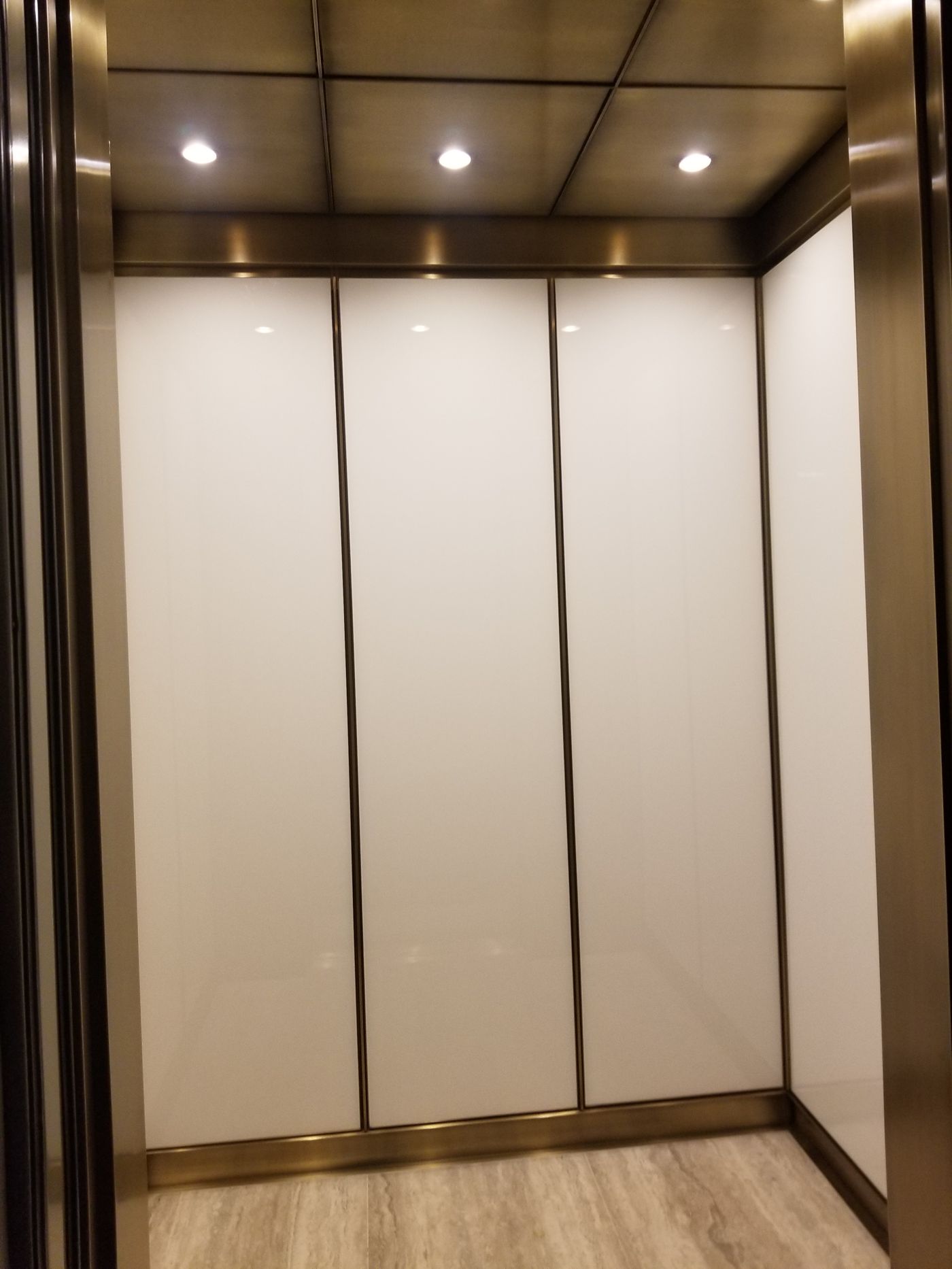
The inside of the cab, the part every single rider looks at, leans on and remembers, mostly got treated as the last thing on the list. It gets handed to an architect who picks finishes without always knowing what those finishes weigh. Or to a general contractor who orders whatever the cab shop has handy. Or to the elevator company, which has every reason in the world to keep the interior plain and cheap. There has almost never been an independent voice fighting for the owner on the cab interior the way there always has been on the machinery.
And that matters more now than it used to. A cab interior today is real engineering, not decoration. Stone, glass and heavy gauge metal all carry weight, and that weight lands on the same counterweight and load numbers, under the same A17.1 cases the mechanical consultant already sweats over. There is custom lighting and LED work. There are fire rated wall and ceiling assemblies that have to pass code and still look like something you would be proud to open in a nice lobby. Write a cab interior spec without the engineering behind it and you have not just made an ugly car. You have created a structural and code problem that shows up on the exact same load cases and tests the rest of the trade was built to protect.
Cab interior consulting is the same job, one floor down
So here is the connection I want to make. Elevator consulting was born because buildings got complicated enough that an owner needed somebody independent standing between him and the people selling him equipment. Somebody whose only job was to protect his interest in a system he had no real way to judge on his own. Cab interior consulting is the same thing, one floor down. Owners, GCs and architects usually do not know which fabricators and installers are any good, what a real lead time looks like, how to turn a pretty rendering into a spec you can actually build, or how to catch a weight problem before it becomes a failed load case instead of after.
The trade that grew up around John Miller, Charles Lerch, and the founders of firms like VDA and Lerch Bates did not happen because owners got less capable. It happened because the equipment got more specialized than any one non specialist could size up alone. The same thing has happened to cab interiors. Custom finishes, built in technology, and the sheer number of choices an owner has today blew right past the pick from a catalog approach, the same way the whole elevator blew past the ask the manufacturer approach seventy years ago.
That is the seat I sit in. Sales, design, rendering that respects the engineering, weight and material analysis, and coordination with the fabricator and installer, all of it working for the owner and not for whoever is trying to sell the panels. It is not a new idea. It is the same idea the elevator consulting business was founded on, finally pointed at the one part of the car every rider actually sees.
Vertice is independent elevator cab interior consulting. Owner side design, rendering that respects the engineering, weight and load compliance review, code and buildability vetting, and fabricator coordination, all before a single panel gets built. Reach me at nick@verticeecc.com. Mind the cab.
Planning cab interior work?
Talk to us before the first panel goes up. The first consultation is complimentary.
Book a Free Consultation Call 917-963-6063